To have your life acknowledged.
To have someone say:
I see you.
You were here.
You mattered.
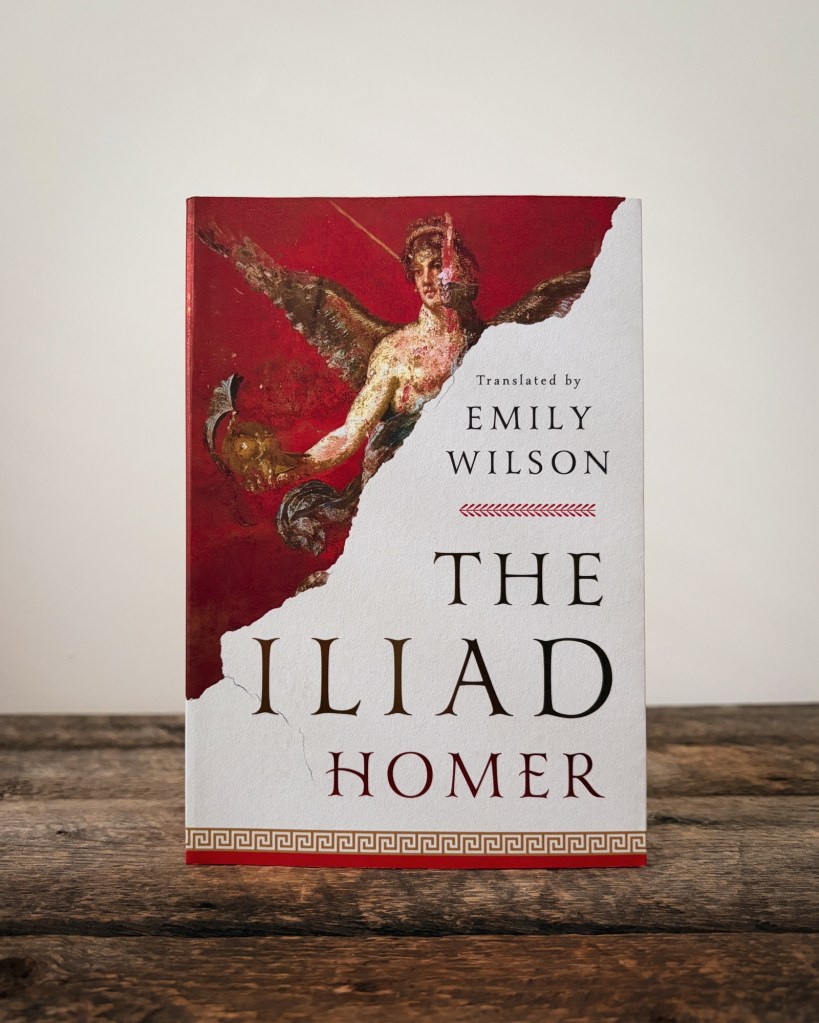
One thing that surprises me, looking back through my notes, is how little I want to talk about the gods.
They are everywhere in this poem. Arguing, meddling, seducing, deceiving, prolonging suffering, choosing favourites and moving lives around like game pieces. Entire books are shaped by their interventions. And yet, when I think about what will stay with me, it is not Zeus (frankly, he disgusts me) or Hera or Athena.
What remains, what always matters, are people.
Patroclus weeping because others are suffering. Hector standing outside the walls knowing exactly what awaits him. Priam crossing into the enemy camp because love demands it of him. All mighty moments of cinema.
So sure, the gods can alter outcomes. But it is the humans who give the poem its heart.
I wasn’t prepared for Hector.
Like many people approaching The Iliad for the first time, I arrived expecting Achilles to dominate the experience. That the climax of his rage and fury driven by all-consuming grief would be how this epic sticks the landing. Not at all. Instead, somewhere along the way, Hector became the character I carried with me. He was flawed. He doesn’t win. He accepted his fate.
And in that he remained recognizably human: his imagination is always occupied by other people… his wife, his son, his parents. The city behind the walls.
Even at the end, when Priam and Hecuba plead with him to come inside, what devastated me was that everyone who loved him valued his life more than his reputation. I ached for Hector.
For all its battles, The Iliad repeatedly returns to the same tension: the distance between being admired and being loved. Or being known, remembered. Book 22 belongs to Hector, and to me.
The night I finished the poem, I reached out to someone I had cared about deeply.
Alas, there was nothing left to solve or say. No revelation waiting at the end. No hidden answer that might rearrange the past into something easier to live with. And that didn’t surprise me. I mattered less than I hoped. Clarity. Finality.
So I finished Homer’s poem thinking about them.
Priam does not go to Achilles because he expects a different outcome. Hector will still be dead in the morning. He goes because there is nothing else he can do. Because staying away is worse than going. And maybe he goes because love and grief give him no other direction than there. Or I suppose he has nowhere else to go. Sometimes we just don’t.
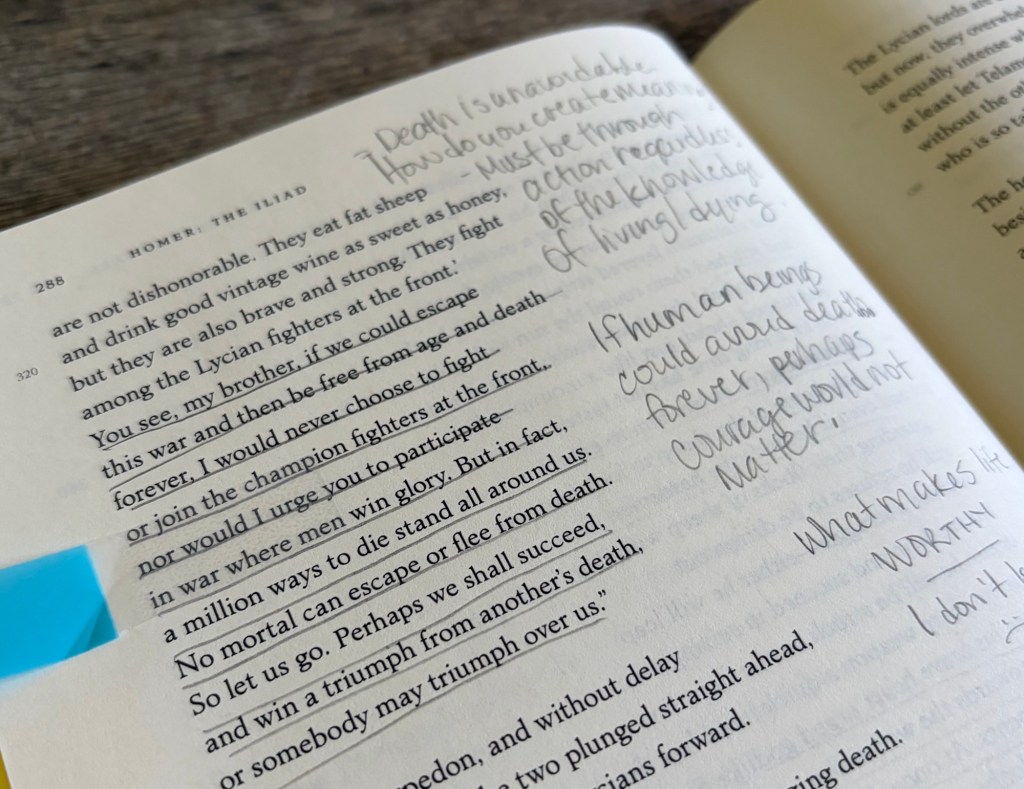
So some acts are meaningful regardless of what they change. Some acts are meaningless. And that’s always where I struggle, but I’ve learned that if it is meaningful for me then that is enough.
I have been thinking about that for so long now. About what remains when possibility falls away and reality finally settles in.
About the dignity of caring for someone despite… everything.
I care.
Without needing the feeling to become anything else.
Just… I care.
Without turning uncertainty into a verdict about my worth.
Because… I care.
Without demanding that another person carry what they cannot carry.
And so I carry. And care. And accept.
It was always very clear to me that I wasn’t really reading Achilles and Priam from a distance. I think I was standing beside them too, not literally, dramatically, romantically, of course… but emotionally.
Which tracks for me. It is how I read books. I don’t tend to follow plots as much as people. I’m often wondering who they love, who they miss, whose voice they are carrying around inside themselves. And why.
Perhaps that is why the gods never became the center of this story for me.
I registered Hector.
I registered Priam.
I registered Patroclus.
I registered the ordinary warriors standing around Patroclus’ body.
I paid a lot of attention to attachment.
Who are they to one another?
Who waits for them?
Who is grieving them?
Who is standing beside them?
The same thing happened whenever the armour came off.
Not literally every time, but it was a fascinating way to symbolize how armour carried reputation, status, duty, glory.
Patroclus in Achilles’ armour.
Hector wearing Achilles’ armour.
Priam kneeling before Achilles.
Achilles weeping.
These were some big images for me. So whether the armour is stripped off someone or removed voluntarily, what’s left is simply a grieving father, a devoted friend, a frightened son, a husband saying goodbye to his wife.
The poem kept reminding me that beneath the armour was just a person being loved and lost. For Achilles in Book 18, totally stripped bare and before new armour arrives, nothing mattered anymore. His companion was gone, certainty was gone and his future was gone. You could feel the rawness of his grief and despair. And then the shield came, and wow, it was wild to stand on that threshold with him.
I wear armour. Not heading into battle anytime soon but I did remove it once, for someone, and it didn’t turn out so well.
Sometimes I worry that I do this too much.
That I care too much.
Reflect too much.
Feel too much.
That I assign significance and meaning where none exists. But every book (yes we’re still on books, sort of) that truly matters to me seems to argue the opposite.
Again and again, I find myself moved by the same things:
recognition,
being known,
being seen,
being chosen,
being loved.
And companionship most of all.
I don’t know if these are small concerns or large ones to other people. I only know Homer was writing about them three thousand years ago. And if they were worth writing about then, perhaps they are worth paying attention to now.
By Book 13 I was completely fixated on the deep camaraderie that runs through the entire poem. Men standing beside one another, fighting for one another, grieving one another, and even carrying one another. Why? Because bravery does not exist alone.
The glory, the gifts, the praise, the individual acts of heroism… those things increasingly felt secondary to what I found at the poem’s center: relationships, loyalty, encouragement, brotherhood, and the gap or the absence left behind when someone is gone.
Then I reached Books 16 and 17. And suddenly it felt as though the poem revealed what it had been doing all along:
Grieving.
I read The Song of Achilles a few years ago, and perhaps that deepened the weight of Patroclus’ death for me. But I’m not entirely convinced. I was very surprised how present their companionship already is in Homer’s poem, and how clearly the depth of their attachment emerges from the text itself. And so in Book 17, the grief for both Achilles and Patroclus’ felt enormous.
By the time I reached Book 18, the poem brought that grief fully into the foreground. And I found it beautiful.
I’ve been carrying a great deal this year.
A connection ending. A final reach. The realization of limits. The clarity that arrives when reality finally settles into place. The relief that comes with clarity. The sadness that accompanies it.
The loneliness that sometimes accompanies acceptance.
For a long time I treated grief as evidence that I was stuck.
As evidence that I should have moved on by now.
That if I were stronger, wiser, healthier, I would have reached the other side already.
But The Iliad offered a different possibility, at least as I experienced it.
Priam is not failing because he grieves Hector. Achilles is not failing because he weeps.
Their mourning is not evidence of weakness. It is part of the journey itself. And proof that love existed. And we all know that is a beautiful thing.
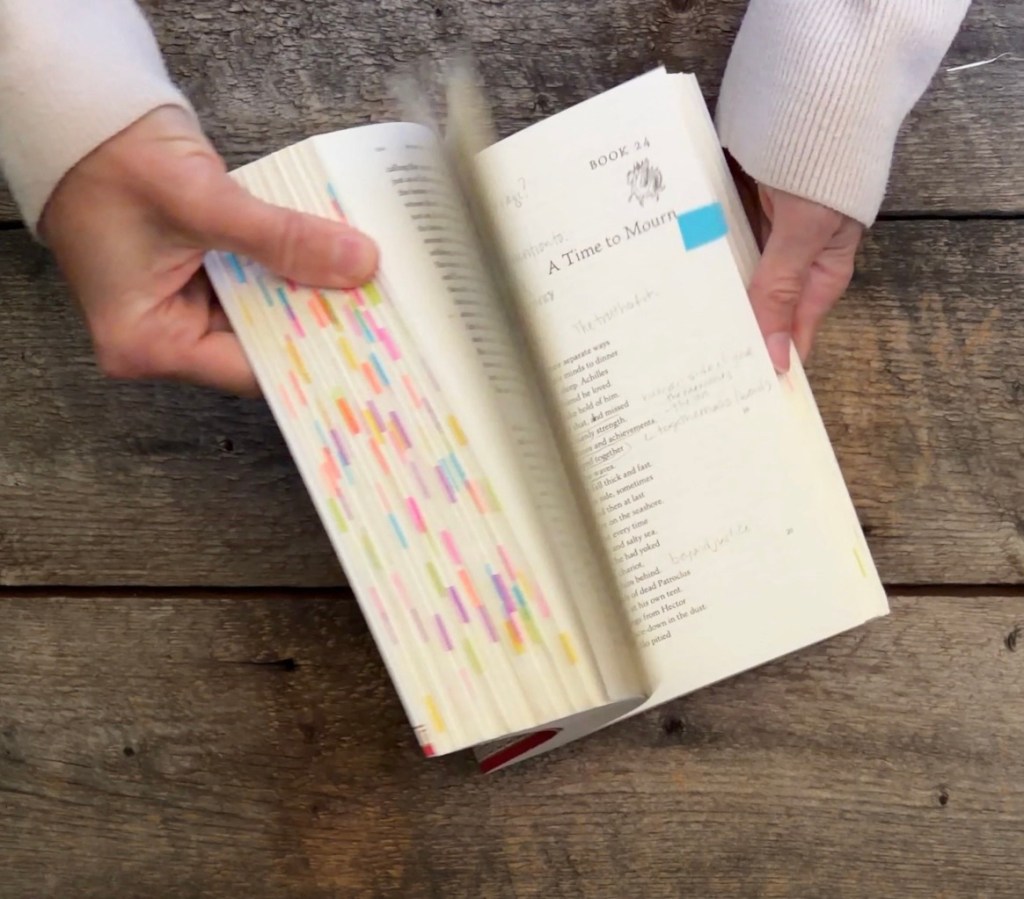
I suppose that is what I have been searching for all along.
To be registered.
To have my life leave some imprint in the people I love.
And perhaps that is why I read the way I do.
I register people.
Their words.
Their silences.
The things they reveal and the things they do not.
Sometimes more deeply than is comfortable. Often more deeply than is reciprocated. And always to my own heartbreak.
But when I look back at everything this poem has left me with, I am wondering if that is not a flaw at all. Perhaps it is simply my attention. The shape of my love or how I love or my capacity for it.
Maybe one day I’ll believe all the evidence I’ve collected about who I am and stand comfortably inside it. As comfortably as I do with Priam, Hector, Patroclus. For now, it sits in small piles around my desk.
And here.
A poem ending.
A chapter ending.
A woman closing one book and one chapter of her life in the same week.
Learning, slowly, that grief is not evidence of failure.
It is evidence that something (or someone) mattered.
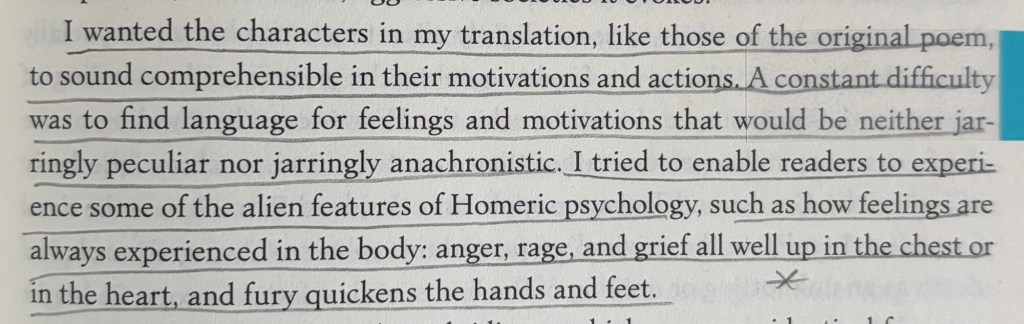
Note: I read Emily Wilson’s translation of The Iliad. Her introduction was one of the most insightful pieces of literary framing I’ve encountered and shaped much of how I approached the poem, particularly its attention to grief, mortality and the emotional lives of its characters. A spectacular read, cover to cover.
 robyn reads books
Leave a comment