Want the anatomy of my recurring obsessions? I do.
There are books I loved, books I admired, and books that shape the way I read. This is one of the latter.
As I build this little reading room, you’ll see certain questions and themes resurfacing with suspicious regularity. Not intentionally. Yet they explain both why I read the way I do and why my shelf looks the way it does.
Why I’m drawn toward interiority.
Why consciousness fascinates me.
Why loneliness keeps appearing in my reviews.
Why “being seen” keeps appearing. (Whatever that even means. Totally sketch term imo.)
Why so many of the books that resonate are preoccupied with identity, alienation, perception, and the weird human desire to somehow register our existence in the world.
Do I need to explain this? No. But that’s me, I like to (over)share as a way to process my thinking. To have a pretend conversation with a pretend someone… because isolated and lonely… because no one gets me… because I have shields… because I have no one to share my depth with… because because because.
I never set out to build a reading life around these questions. They are just naturally becoming the skeleton, the soft tissue, all of the inside of me.
So looking back, No Longer Human can be found in the anatomical illustration of my grief-stricken emotional architecture.
This book is almost pure alienation.
Pure self-consciousness.
Pure performance.
A person who feels fundamentally unable to participate in human life the way everyone else seems to.
I’ve been reading variations of that question ever since:
What does it mean to be a person?
Kafka asks it.
Lispector asks it.
Kundera asks it.
Harpman asks it.
Before those threads became recurring obsessions in my reading life, Osamu Dazai was asking it too.
Placing No Longer Human on the shelf feels right because it’s origin-story material. A book that has seeped into the deepest, most structural part of my identity.
I read and heavily annotated it during a strange period of my life. One marked by solitude, hurt and this odd yet growing tendency to turn toward books in search of understanding other people and myself.
What follows is what I wrote closer to the experience itself.
Side note, regarding terms, I may have bounced a bit between human anatomy and blueprint for a building. Same same.
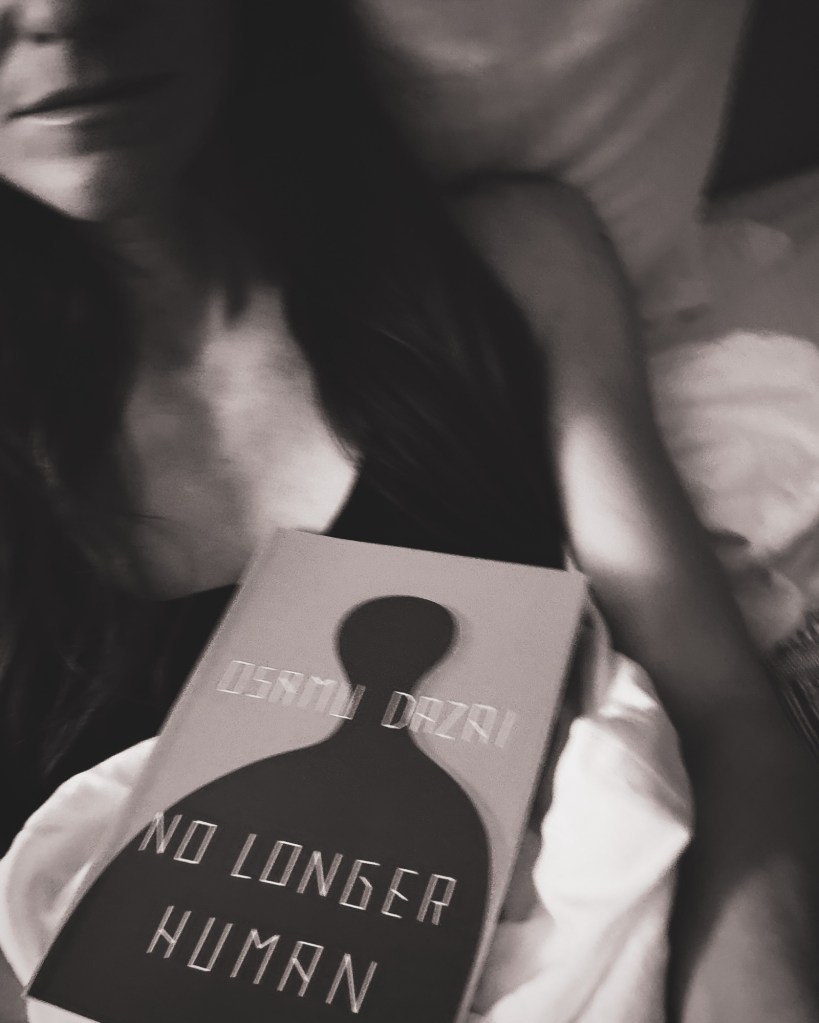
No Longer Human by Osamu Dazai. Posted to IG on March 5, 2026:
Does exposure feel like risk to you? Have you felt that being ‘seen’ may still come with conditions? Does safety live in staying agreeable, light, unthreatening? Do you monitor the room constantly for ‘threats’?
Yes.
Often described as alienation or confession, No Longer Human reads precisely as a life organized around performance. Joking as strategy, charm as insulation, jesting as panic response to silence. Yozo believes himself inhuman, fundamentally misaligned with society, and therefore performs (avoids) accordingly. But his fear is not of being disliked, it’s being found out, and suffering the pain that goes with that.
His despair unsettled me, yes. But it was his certainty, the conviction, that pulled me in. Every interaction confirms his defectiveness. Every kindness, a misunderstanding. Every failure, proof. Proof of not qualifying as human.
I am convinced that human life is filled with many pure, happy, serene examples of insincerity, truly splendid of their kind of people deceiving one another without (strangely enough) any wounds being inflicted, of people who seem unaware even that they are deceiving one another.
I kept thinking about how an internal narrative, repeated long enough, can harden into architecture. He never questions his. I do. Am trying to anyway.
-where do I confuse my defensive armour with my true self?
-at what point did my coping mechanisms turn into my personality?
-when does my need to be safe overshadow my need to be real?
-where/when do I stop? (before existential fracture of course ;)
There’s a point where Yozo doesn’t stop. He moves toward detachment, toward self-erasure. That’s where I felt the edge between us… where he continues toward annihilation, I move toward integration.
The sections on love were the hardest. Not longing for it, fearing it. The idea that being loved is exposure. That if someone truly sees you, the mask must fall. And if you’ve ever let it fall, trusted that it would be held carefully, you know how vulnerable that is. And when someone can’t hold what they reach for, you learn where your edges are. So… armour up, perform, hide. And on and on we go.
The epilogue is where the shift happens. Yozo is described as gentle. Ordinary. Human. The world did not experience him as the monster he believed himself to be. It’s tragic. He was never irredeemable, he just never allowed for the possibility that his story about himself was wrong.
The margins: this is the first book I’ve ever annotated. Not academically. I don’t really know the rules. The margins just became a place for personal reflections, part diary, part boundary-setting exercise, part trying to ‘see’ myself, and Yozo.
A visceral/relatable read because it:
-names masking without dramatizing it, without ‘meme-ing’ it, without diluting it
-examines people-pleasing as survival
-understands how self-narratives can lead to fate
-refuses redemption (which makes the epilogue devastating)
-forced me to locate the edge between recognition and self-erasure
-met me in winter, quietly, and made me aware of my own interior narratives
For someone like myself in whom the ability to trust others is so cracked and broken that I am wretchedly timid and am forever trying to read the expression on people’s faces.
 robyn reads books
Leave a comment