I finished The Iliad looking for evidence of what mattered and carrying grief. I expected The Odyssey to carry me somewhere entirely different. Home, and all its many meanings, was my first assumption. That seems obvious enough. It is probably the first thing most people know about Homer’s second epic. A man spends years crossing impossible seas, coping with impossible losses, trying to return to his wife, his son and his kingdom. Emily Wilson certainly prepares us for many of those ideas in her introduction: identity, homecoming, wandering, survival.
Instead, home feels more like the frame, and one to be tested. I found myself paying surprisingly little attention to the journey itself. Almost immediately, I became invested in seeing what happened whenever two people stood before one another. Those moments carried a kind of electricity for me. They always seemed to reveal something the battles and monsters couldn’t. So the adventures became almost incidental. I wasn’t hanging about the Cyclops or the Sirens so much as the spaces where the plot slowed down and people simply had to face each other (and themselves).
And long before Odysseus walks through the door, people already have an idea of who he is. They have memories, rumours, songs, stories. Sometimes that’s all they have. I didn’t know it yet, but that thread would become one of the biggest ideas I carried through the poem.
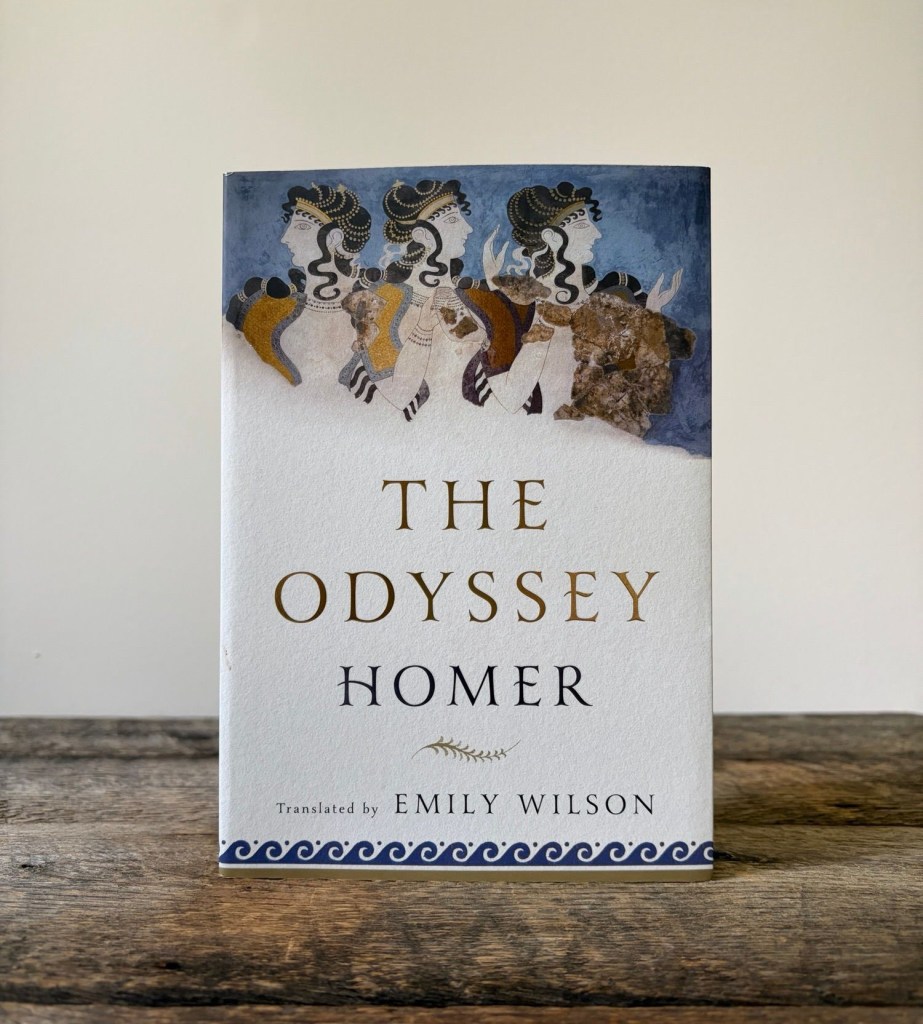
Stories arrive before Odysseus does
Book 1 softly plants this idea without making much fuss about it. Athena begins telling Telemachus who his father is before we, as readers, really know him ourselves. Then Books 3 and 4 continue that work as Nestor, Menelaus and Helen each add another version of Odysseus. Every account illuminates him a little more, but none of them quite captures the whole man.
Telemachus captivated me immediately. No surprise there; I attach easily to boys in stories, especially coming-of-age, to boys who bloom into their own self in absence of a mother or father. And for him, he is trying to build a father out of other people’s memories during his own becoming. It was absorbing to think: Can someone really know another person through stories alone? And what does a parent’s absence do to our own becoming?
The famous hero suddenly has to live inside his own reputation
Meeting Circe while concurrently reading Madeline Miller’s novel was a delight, but something else caught my attention.
Before she ever meets Odysseus, she already knows his name. Or rather, she knows the stories attached to it. His reputation arrives before he does, just as it does throughout much of the poem.
Odysseus understands that. He walks into the encounter already carrying other people’s versions of himself – the admiration, the fear, the expectations that have gathered around his name. Before he has spoken a single word, he has already been imagined. And he’s actually nervous about it.
Reputation is a strange thing. It can be a gift, a disguise, a shield, an expectation, and sometimes even a prison. It seems to shape every encounter before you have the chance to shape it yourself. And sometimes that feels really unfair.
On hospitality
At first, I found it a little funny, a bit extra. Everyone seems wonderfully excessive about welcoming strangers. Sit down. Eat first. Drink some wine. We’ll figure out who you are afterward.
The more I read, though, the less it felt like a matter of good manners.
Before anyone knows your name, your history, or whether you’re worthy of trust, you’re offered food, warmth, and a place to rest. Care comes before identity. Before explanation. Before proof.
The gentleness struck me. It was dignity.
By the time Eumaeus welcomed a ragged beggar into his home in Book 14, fed him, listened to him and spoke kindly to him without knowing he was actually speaking to his king, I had completely fallen in love with him. Of course I did. He’s steady, kind, faithful, expects nothing and simply does what is right. He is exactly the kind of character I always end up carrying with me.
I’ll never forget writing in the margins,
I love Eumaeus too.
He does not lover her in the way she wants
I can see how easy it would be to flatten Calypso into a captor in Book 5. There was something tender here and so, and not at all surprising, I was sympathetic towards her. She explains why he’s in her care… everyone left or is dead. The war, his war, had taken everything. And there was simply no one to hold this exhausted man.
And then her loneliness of being the person who loves someone already looking elsewhere. Across the sea. And she can’t change this.
She cannot become home for him so she lets him go, warmly, lovingly. It felt deeply human and familiar. So I felt sorry for her, or me, or both of us.
I couldn’t help but think how complicated love can be when care exists, but home does not.
The bridge back to The Iliad
Even as the poem moves away from Troy, Homer reminds us that companionship hasn’t disappeared and Book 8 reached back into The Iliad to offer brotherhood again.
Almost casually Homer gives us the line:
“A friend can be as close as any brother.”
I stopped. I had spent nearly an entire essay writing about camaraderie. Then, one sentence and suddenly Patroclus was standing beside Achilles again. The battlefield, the loyalty, the impossible grief of losing someone who feels so much a part of you. Homer somehow reached back into the first epic and handed this to me again.
What was it all for?
Book 11 may be the strangest book in the poem. The underworld. The prophet. His mother. Agamemnon. Ghosts.
Odyssues meets Achilles. Homer brings him back and places him among the dead. The greatest warrior of the Greek world is no longer speaking from the battlefield but from mortality itself.
I won’t pretend I understood this one but I do remember laughing to myself afterward and writing something wonderfully unacademic:
The glory of war ain’t that glorious.
This was the next major bridge back to The Iliad. Achilles himself confirms it. Glory doesn’t erase loss and it certainly doesn’t erase death. And beneath the armour was just a person wanting to live, to be loved, and then is lost. Somehow Homer managed to make the second epic deepen my understanding of the first.
What even is ‘home’ now?
For twelve books, it’s storms, monsters, gods, temptation, grief, exhaustion. Every obstacle exists to delay the inevitable moment when Odysseus’ feet finally touch Ithacan soil in Book 13. He wakes up, looks around, doesn’t recognize it. The place he has spent years imagining exists exactly where it always has, yet reality refuses to match the image he has carried across the sea. This is where Homer dismantles the idea that home is simply a destination. Odysseus arrived geographically, but nothing inside him has caught up yet.
Looking back at my notes,
Safety is an element of what home means,
I think that was my first attempt to name what felt so significant about this scene. Home wasn’t Ithaca, it was the place where he no longer had to survive. Where he could finally stop scanning the horizon, stop performing, stop scheming, stop calculating every conversation, stop wondering who could be trusted. But he is not there yet.
I was fascinated by his conversation with Athena
Neither of them begin with the truth.
She arrives disguised and he responds with another carefully constructed story. Oh the cleverness here, I smiled at the similarity between them. Athena eventually reveals herself and even seems to admire the very quality that has kept Odysseus alive:
“His mind was always full of clever schemes.”
But I found myself wondering about the cost of that cleverness.
For years, disguise, suspicion and half truths have been survival. Now he’s finally home but can’t simply say, “I’m Odysseus.”
This exchange was another favourite moment:
Odysseus doesn’t simply thank Athena.
He calls her out. He asks, in essence,
If you’ve been helping us all this time… where were you?
I loved that. It wasn’t criticism, it was human. Because after everything his family has endured, after Penelope’s years of waiting and Telemachus growing up without a father, gratitude isn’t his first instinct. Questions are. Athena answers that Telemachus needed to earn his own glory…. maybe.
I’m still not entirely on board with that position.
A small nod to when Odysseus worries about his treasure in this book, which felt… odd. I guess if you’ve survived said monsters, storms and total loss of your crew, you would do a final check on your luggage. I know it’s the deeper layer, when we’re exhausted and disoriented, we often cling to tangible things. So treasure is proof here, that a journey happened, he is still himself and survived.
Fathers and sons
Books 14 through 16 may be my favourite stretch of the entire poem because the homecoming is no longer theoretical, people are beginning to find one another.
Eumaeus continues grieving the master he believes is dead while unknowingly feeding him. Odysseus finally hears what his absence has done to the people who loved him.
Telemachus returns. By then, I already knew him. Now, father and son meet. Odysseus watches his son before revealing himself. He saw a young man, not a boy, who had grown into kindness, caution, loyalty and responsibility. This reunion mattered so much because there was already recognition. The blood relationship explained who they were to one another, but the deeper emotional truth was how they were both affected by the same absence, hope and love. Homer allowed this moment to become what so many reunions are: joy tangled up with grief for all the lost time.
Later, after all the violence, Telemachus simply goes and sits beside his father. It was such a quiet sentence for such an enormous relationship.
Recognition
The anticipation is almost unbearable in Book 19. Clever, scheming Odysseus finally arrives to his own house, a stranger, in disguise. Penelope welcomes him with such kindness, eager to hear any news of her husband, while he sits there listening to the she has lived in his absence. What on earth must he be thinking? For so much of the poem its been his longing to get home. Suddenly I was watching him hear the cost of all those lost years through her own words.
This line stopped me:
“She wept for her own husband who was right next to her.”
Homer wonderfully makes proximity more painful than separation.
Then, she asks for evidence.
Of course she does.
I would ask for evidence too.
You have to.
Don’t you?
What else do years of stories teach us? At some point, words are not enough. Hope alone is not enough. She needs something she can trust.
Then Homer slows everything down.
Eurycleia recognizes him not through prophecy or fate, but through touch. Through memory. Through caring for him when he was a child. His scar.
This book made recognition feel very layered in how it arrives. Perhaps it’s through memory first, then evidence, and finally through the courage to believe who is actually standing right in front of you.
Book 22 is astonishing
It brings together justice, violence, loyalty, and, finally, father and son standing together. But what surprised me was this weird emotion I had for Athena.
Earlier in the poem, I wasn’t quite sure what to make of her constant intervention. A little suspicious because, at times, it almost felt excessive, nudging the events along. By the end, though, I saw something entirely different. She had never abandoned this family. Through all the disguises, delays, grief, and uncertainty, she remained remarkably steady. As everything finally came together, I realized I felt a genuine pang for her too. Somehow, she’d been carrying this family home all along.
Then Homer gives us Book 23
I don’t think I’ll ever forget reading it.
Somewhere in the middle of the book, I wrote:
She needed so much convincing.
Then, immediately:
I need so much convincing.
I don’t think I’d realized that about myself until I wrote it.
At this moment the poem stopped being about The Odyssey and became about me. And, if I’m honest, that’s usually how I know a book has truly found me.
Telemachus grows impatient with his mother. The old nurse begs her to believe him. Odysseus is sitting by the hearth waiting. The suitors are dead. The danger has passed. It’s over.
Maybe.
But how do you resolve twenty years of waiting in a single evening?
How do you step out of living in uncertainty for so long?
She’s been defending their home, honouring her husband, and surviving only on hope.
So what does happen when much of life is lived in hope and story?
You learn to be careful with belief.
Penelope crosses the threshold, and even then she remains wonderfully steady. Telemachus scolds her. Everyone around her seems to think recognition should happen immediately.
She waits.
Then Homer gives us one of the most beautiful lines in either epic:
“We have our ways to recognize each other, through secret signs known only to us.”
Not appearance.
Not reputation.
Not another story.
A shared life.
A shared memory.
The bed that only the two of them could truly know.
When she finally believes him, she runs to him, throws her arms around his neck, kisses him, and says,
“You made my stubborn heart believe in you.”
I cried.
Because she never doubted him, she doubted reality. She hadn’t been withholding love. She had been protecting it. And protecting her heart too.
And then Homer gives us one final gift.
After everything – after the war, the wandering, the disguises, the waiting, the recognition – they make love. And then they tell each other stories. I loved that… because now they were doing that together.
One last surprise
I expected Homer to end with Odysseus in Book 24. Instead, he gave us another father.
After The Iliad closed with Priam, I couldn’t help but notice Homer returning once again to the relationship between a father and his son. This time it was Laertes. Another recognition. Another reunion. Not built on appearances, but on memories that only the two of them could have shared.
As the poem drew to a close, I found myself writing one last question in the margins:
Can Odysseus ever be at peace?
Or has war become too much a part of him? Can a man who has spent so long surviving ever truly settle back into ordinary life? To home?
As for the gods…
No change to my (lack of) interest in them. But I loved that Athena and Zeus end the journey with peace. Because if the The Iliad ends with shared grief, The Odyssey ends with the possibility of peace. Possibility, not certainty. And that’s enough.
Finally, on home and me
Looking back, I don’t think The Odyssey was only about home. Homer certainly gives us that language, but by the end I found myself returning again and again to stories, memory, reputation, recognition, and how difficult it can be to truly know another person.
Maybe that’s what home slowly became for me.
It’s where recognition becomes possible. Where stories eventually give way to the person standing in front of you.
And perhaps that doesn’t only happen between people. I think it happens within us too.
The longer I sat with this poem, this essay, the less home felt like a destination waiting somewhere over the horizon. It’s a place inside ourselves that we slowly rebuild after grief, after love, after loss, after being blown off course. A place where we no longer have to survive, perform or live entirely inside the stories we’ve told about ourselves.
This whole Homer journey has felt like moving toward that kind of home. Not one I had to find, but one I am slowly learning to inhabit.
To recognize what has been there all along and keep building on that.
To finally say, with conviction,
“Yes, this is who I am.”

 robyn reads books
Leave a comment