Meeting a Consciousness
No notes on existentialism or absurdism. This is not Camus is brilliant or here’s what the book means. It’s not even Meursault’s resistance to the performance of the social arena. (Yes, even I’m surprised by my lack of interest in the latter, given my increasingly obsessive hatred for the performative out there.)
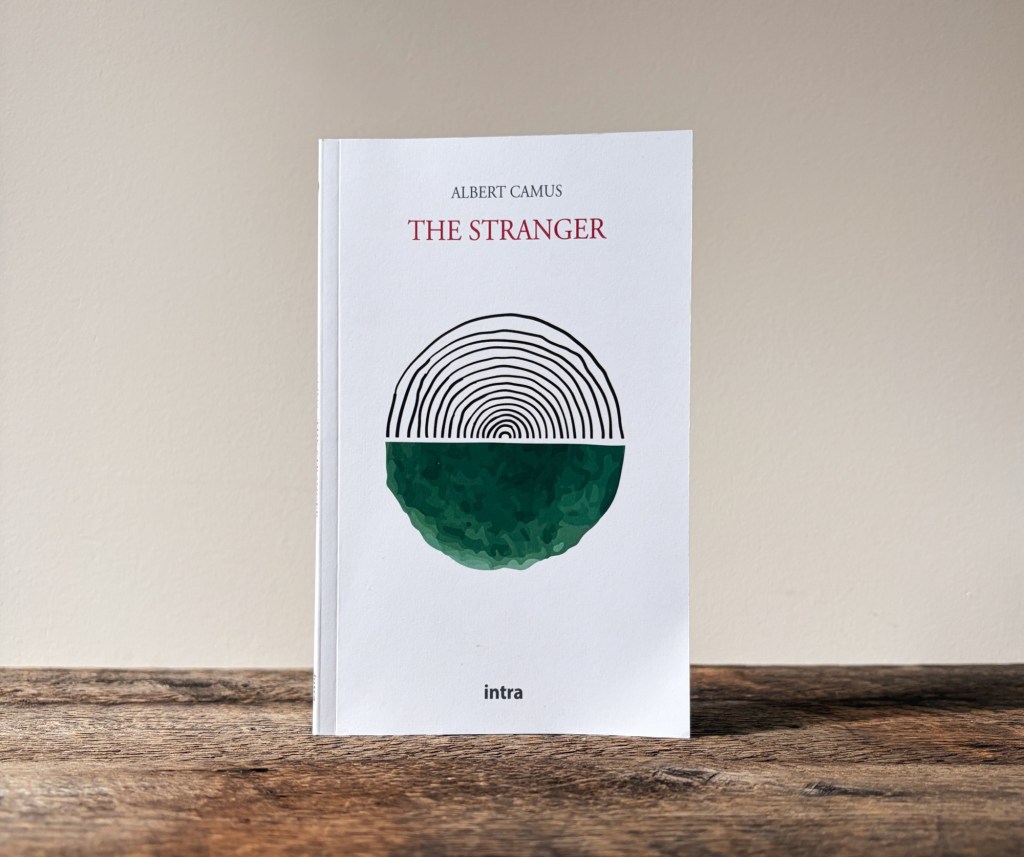
I spent the first forty-five pages of The Stranger waiting for Meursault to become emotionally available to me. It wasn’t out of sympathy that I wanted this, or even because I needed to find a way into his heart and mind so I could connect with him as a character. I just wanted him to be… available. To give me something to work with. We couldn’t quite get there.
What was available from Meursault was what he noticed. He kept telling me about:
The weather.
A meal.
The light.
A cigarette.
A woman’s laughter.
The sound of someone’s voice.
The heat. (Always the heat.)
Physical things. Sensation.
At first, I mistook this for some kind of detachment. I felt quite detached from him myself. Maybe it was absence. Whatever it was, I went straight to wondering what had happened to him. My curiosity can be almost annoyingly persistent when I encounter someone who behaves in a way I can’t immediately place, on or off the page. And this man seemed only to feel ‘alive’ when there was something physical happening. Sensory, even painful. I started looking for the information underneath it. What happened? Where did this come from? What am I missing?
Surely there had to be an origin story. Some wound. Some psychological key that would unlock the distance from which he narrated the world.
But then something happened that interested me far more than whatever answer Camus may or may not have intended here. I noticed a clear shift in myself. From wondering what he was about, to wondering why was I trying to understand him so much, (default wiring I guess that gets me in trouble sometimes), to attending to his consciousness and what it was doing.
As always, that distinction matters to me.
A year ago I wanted to know whether I was understanding a novel correctly. Now I’m desperate to know what it is like to inhabit another consciousness for two hundred pages.
I don’t want to become that person.
I want to know how a mind organizes reality.
Kafka’s K. tried to impose order on a world that continually refused him in The Trial. Yozo, in No Longer Human, seemed to perform consciousness, always aware of the gap between himself and everyone around him, forever trying to disguise it.
Meursault does something else entirely.
He notices. Or perhaps it’s more accurate to say, he tells us what he notices.
That became the question I couldn’t shake. Not even close. And yes, we’re going to project now, an obsession I excel at.
“I may not have been sure about what really did interest me, but I was absolutely sure about what didn’t.”
Every first-person narrator is selecting.
Not lying, necessarily.
Selecting.
Every sentence shared brings something into the frame and leaves something else outside it. And I think that selection becomes part of the reality we experience. What is noticed. What is described. What never enters the frame at all.
Meursault wasn’t intentionally withholding something from me (I don’t think). He was giving me his field of attention. The heat. The light. The cigarette. The body. The sound of his own voice. This was the world available to me.
That made me think about how I understand other people. I’m always working with what has been selected for me. Sometimes I’m trying to understand someone’s reality; sometimes I’m trying to understand the reality between us. Either way, I’m assembling some kind of working version of the whole from the pieces I’ve been given. All for the sake of understanding the position I occupy inside said reality, whether I’m reading a narrator or sitting across from another person.
It’s never the whole thing. I know that.
But I still have to live somewhere in the meantime.
And that can be tough.
So I select. I interpret. I make a provisional draft of reality and carry on as though, at some point, I’ll have enough information to revise it and land a final.
Which, of course, is probably bullshit.
Because when do we ever get the final version?
If you’re still reading, you’re welcome for that existential digression.
By the second half of the novel, I realized I was no longer really studying Meursault. I was studying the act of narration itself. I had become increasingly interested in the choices being made on the page. Why this detail? Why this moment? What is he unable to see? And, perhaps more interestingly, what does he see that everyone else seems to miss?
That is part of why the trial fascinated me. Everyone in that courtroom seemed to be constructing a different version of the same man. The prosecution selected one set of facts. Meursault had given us another. Everyone was arranging the available evidence into some version of reality that made sense to them. None of those versions felt complete to me, and I’m not sure any version ever really is. We are all selecting, all the time, and then living inside what we have selected.
I’ve been carrying this line with me for months, you’ve seen it in my posts: I want to meet a consciousness. Not just a character, but a consciousness. There is a difference to me. A character can serve a plot; a consciousness lets me experience a way of organizing reality that isn’t my own. That is one of the things I increasingly want from books. I don’t necessarily need to like the person I am spending two hundred pages with. I don’t even need to agree with them. Sometimes I don’t particularly want to understand them. I want to know what it feels like to stand inside their particular way of noticing (and selecting) things for a while.
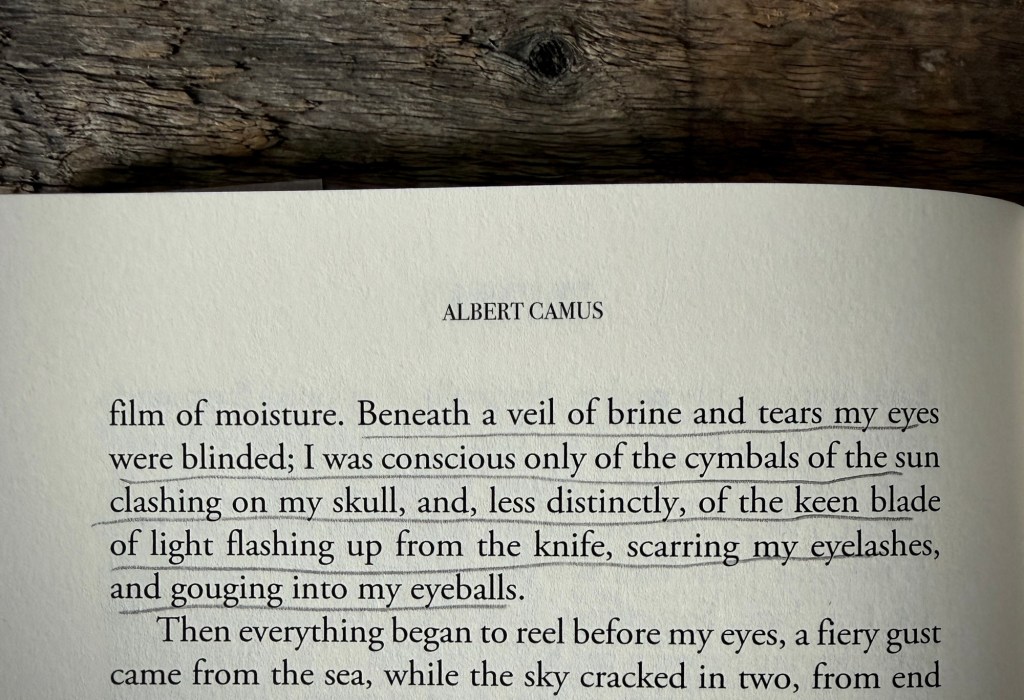
Meursault gave me that in his attention to physical sensation: the heat, the light, the body, pain. There were moments when I found myself responding to that physical immediacy in a way that had very little to do with Camus and quite a lot to do with my own experience. I’ve known conversations where the body becomes the last undeniable place of certainty, where a physical feeling can be easier to locate than an emotional one, especially when everything else feels murky. Meursault didn’t explain any of this to me. Nothing in the novel told me to make that connection. I just found myself there.
This is one of the things I value most in literature. The author doesn’t have to hand me the connection. Sometimes it is enough for it to create the conditions in which my own mind makes one. In fact, to be clear and one hundred percent contradictory, for the love/hate relationship I have with ambiguity, when it comes to books, don’t interpret, don’t connect, don’t explain, but suspend me in some liminal space and let me enjoy my mental free fall.
Wow, extra points for two digressions.
So I find myself less interested now in asking whether Meursault is alienated, or whether he is absurd, or even whether his resistance to the social performance around him is somehow admirable. I’m more interested in what happens when an interior life and a social world seem to be speaking entirely different languages. The court wants to know what kind of person Meursault is. It wants to organize him into something legible, something that can be judged. And yet what I had spent the novel experiencing was something much stranger: a mind that simply kept registering the world in its own particular way, even when everyone around it was demanding a different explanation.
That question has followed me through a lot of the books I’ve loved this year. I’ve already mentioned my delight in the minds of Kafka and Dazai. Nabokov takes consciousness somewhere far more dangerous and Dostoevsky seems almost incapable of letting anyone settle.
And now Camus has left me with my own version of it.
I used to ask, What kind of person is this?
I think I’m increasingly asking, What kind of consciousness is this?
And then, inevitably, the question turns back toward me.
What happened to mine while I was here?


 robyn reads books
Leave a comment